
Speed Limits vs. Safe Speed: Why the Sign Isn't Always the Answer

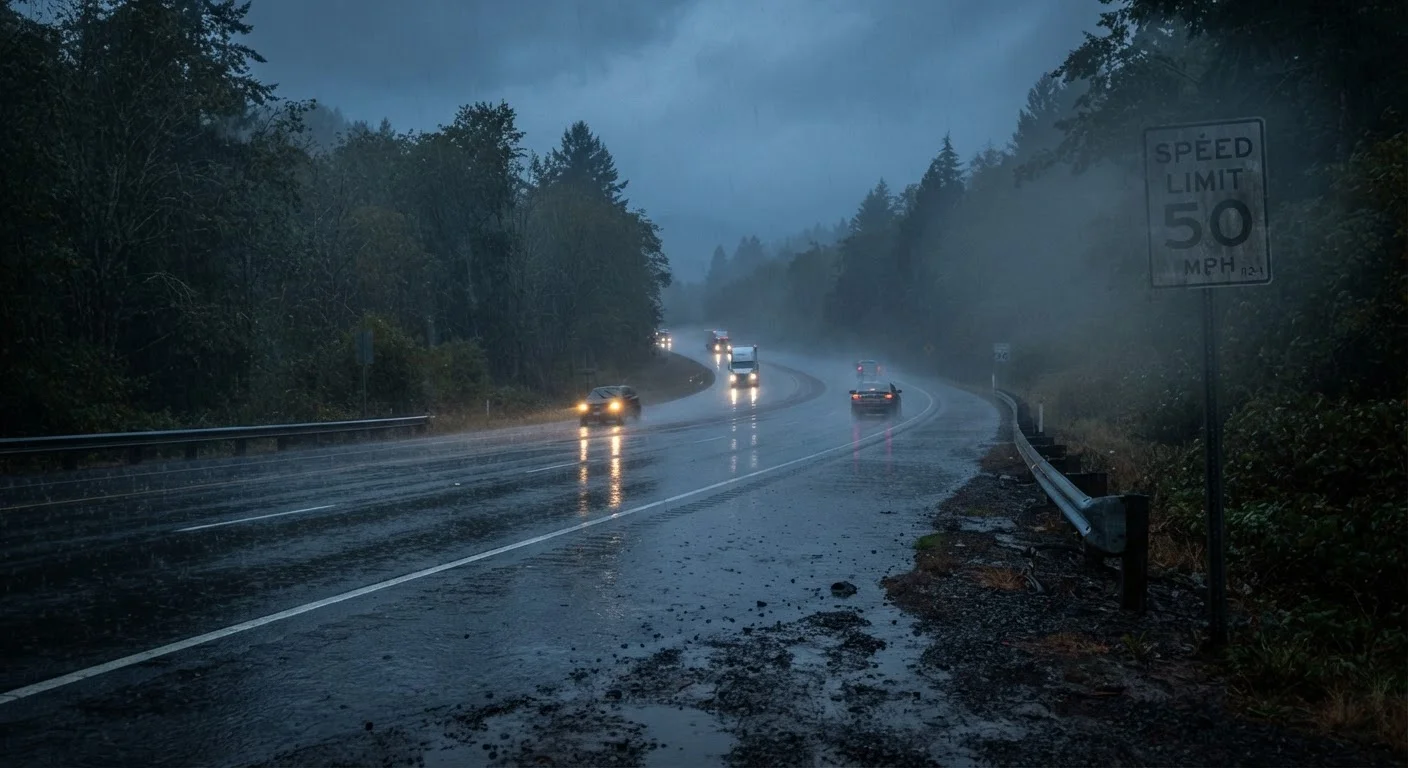
Photo: AscendWit.com | Explore Engaging Blogs. editorial
Key Takeaways
- Speed limit signs reflect legal maximums, not recommendations for every condition.
- Driving at the posted limit can still be unsafe when weather, visibility, or traffic demand slower speeds.
- Most US states have 'basic speed laws' requiring drivers to travel at a speed reasonable for conditions.
- Stopping distance increases dramatically with speed - a small reduction makes a big safety difference.
- Overconfidence at familiar roads is a common factor in collisions, even for experienced drivers.
What a Speed Limit Sign Actually Means
A posted speed limit is a legal ceiling - the fastest you may lawfully travel under normal, ideal conditions. Traffic engineers set these numbers based on road geometry, lane width, sight distances, and typical traffic patterns. They are not calculated with rain, ice, heavy traffic, or nighttime visibility in mind.
Nearly every US state enforces what's commonly called a basic speed law (sometimes called the "prima facie" rule). The principle is consistent: you must drive at a speed that is reasonable and prudent for existing conditions, even if that means going below the posted number. Driving at 55 mph on a 55 mph highway during a whiteout is not legal just because you're under the limit - it can still be cited as unsafe speed.
Think of the sign as a cap on a good day, not a target for every day.
| Criterion | Posted Speed Limit | Safe Speed |
|---|---|---|
| Set by | Traffic engineers & lawmakers | Current road and weather conditions |
| Accounts for weather | No - assumes ideal conditions | Yes - adjusts to actual conditions |
| Legal status | Legal maximum | Required under basic speed laws |
| Changes trip to trip | No - fixed on the sign | Yes - varies with visibility, traffic, road surface |
| Relevant at night or in fog | Still applies, but insufficient alone | Often means traveling below the posted limit |
| Driver responsibility | Don't exceed it | Actively assess and adjust throughout the trip |
When Conditions Override the Sign
Several real-world factors routinely call for speeds well below what's posted:
- Wet or icy roads: Water reduces tire friction significantly. At highway speeds on a wet surface, a vehicle can begin to hydroplane - losing contact with the road entirely. Ice multiplies stopping distance by several times compared to dry pavement.
- Reduced visibility: Fog, heavy rain, glare, or darkness shrinks how far ahead you can see. A core principle in defensive driving is to travel only as fast as you can stop within your visible distance ahead.
- Heavy or unpredictable traffic: When vehicles around you are braking frequently or merging, you need more buffer time. Speed determines how much of that buffer you have. See our guide on following distance for how speed changes the math on the space you need.
- Work zones and school zones: Reduced speeds are often posted and legally enforced in these areas, with fines doubled in many states - but the physical rationale matters just as much: workers and children can step into the roadway with almost no warning.
- Curves and hills: Posted advisory speeds on curves (yellow signs) are separate from regulatory limits and reflect the geometry of the road. Ignoring them is a common single-vehicle crash factor.
~4×
Stopping distance increase from 30 to 60 mph
On dry pavement, stopping distance grows disproportionately with speed - a well-established principle in traffic safety engineering.
33%
Of fatal crashes involving excessive speed
The NHTSA consistently identifies speeding as a factor in roughly one-third of all US traffic fatalities annually.
Every state
US states with a basic speed law on the books
All 50 states maintain some form of law requiring drivers to travel at a speed reasonable for conditions, independent of posted limits.
The Physics That Make This Urgent
Speed's relationship to stopping distance is not linear - it's exponential. Doubling your speed more than doubles the distance needed to stop. At 30 mph, a typical passenger vehicle needs roughly 75 feet to stop on dry pavement. At 60 mph, that figure jumps to around 270 feet - not double, but nearly four times as far. Add wet pavement and those numbers grow further.
This matters because the gap between "the situation looked fine" and "I needed to stop" can close in under a second. Reading the road ahead gives you more time - but only if your speed leaves room to act on what you see.
Advisory Speed Signs vs. Regulatory Limits
Familiarity Is Its Own Hazard
One underappreciated risk factor is driving a road you know well. Familiar routes encourage autopilot behavior - you stop actively scanning, you hold speeds you wouldn't otherwise choose, and you assume nothing unexpected will happen. That assumption is exactly what makes an ordinary commute the setting for a real crash.
Research consistently shows that experienced drivers are not immune to this trap. Habitual errors even confident drivers make are worth understanding precisely because they don't feel like errors in the moment.
Treating every trip - familiar or not - as one where conditions deserve a fresh look is what separates cautious drivers from statistical ones. The speed limit tells you the law. Your judgment, your eyes, and the road in front of you tell you the rest.
This article is for general educational purposes only. Always follow your state's traffic laws and consult official driver's manuals or qualified driving instructors for guidance specific to your situation.
The content on this site is for informational purposes only and is not a substitute for professional advice. Always consult a qualified professional for guidance specific to your situation.