
Whole Grains vs. Refined Grains: What Changes When You Process a Grain

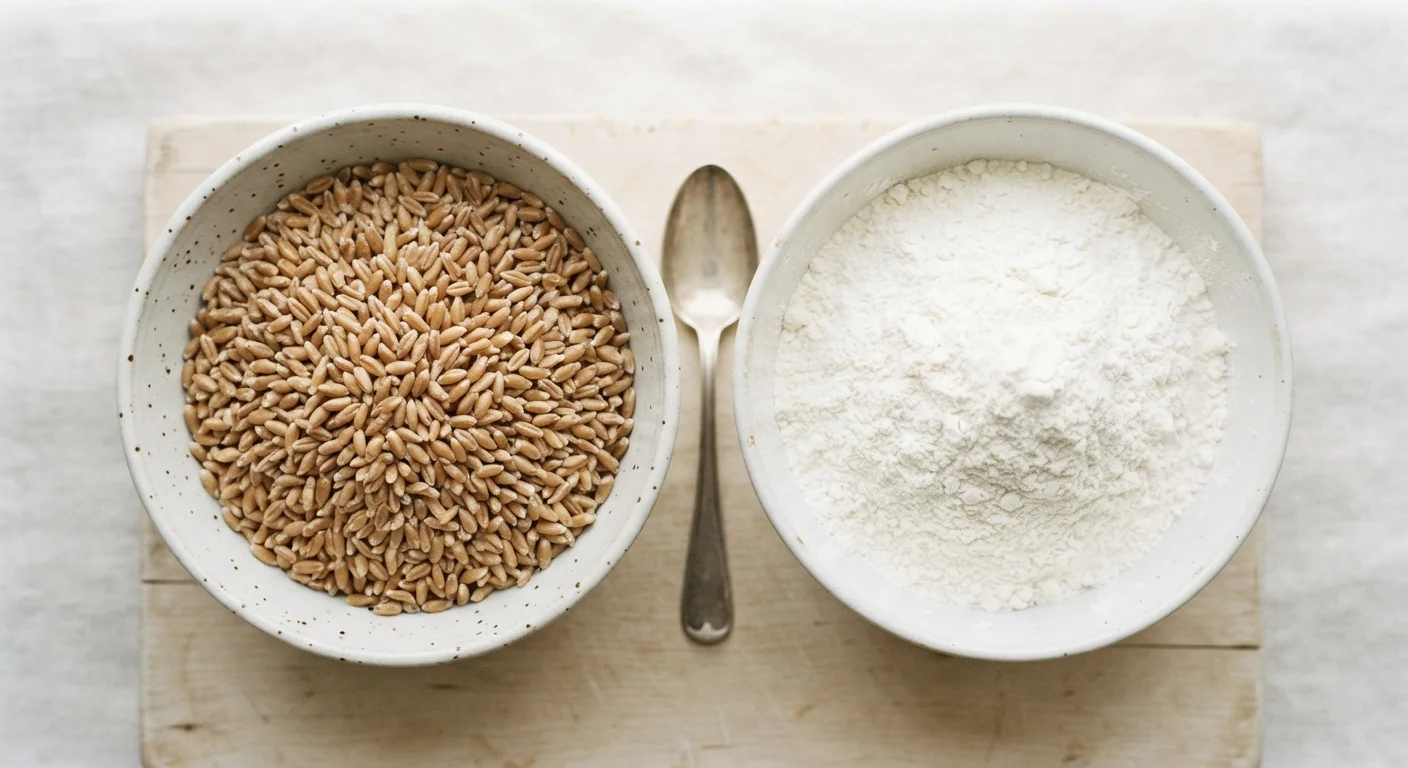
Photo: AscendWit.com | Explore Engaging Blogs. editorial
Key Takeaways
- Refining removes the bran and germ, stripping away fiber, B vitamins, iron, and healthy fats.
- Whole grains contain all three kernel layers: bran, germ, and endosperm.
- Enriched refined grains have some nutrients added back, but fiber is not restored.
- "Wheat bread" or "multigrain" labels do not automatically mean a product is whole grain.
- Most U.S. dietary guidelines recommend making at least half of all grains whole grains.
- Checking the ingredients list for "whole" as the first word is the most reliable label-reading shortcut.
What Happens Inside the Mill
A grain kernel has three distinct layers. The bran is the tough outer shell, packed with fiber, B vitamins, and antioxidants. The germ is the nutrient-dense embryo, containing healthy fats, vitamin E, and additional B vitamins. The endosperm is the starchy center that makes up the bulk of the kernel.
When a grain is refined, milling machinery strips away the bran and germ, leaving only the endosperm. The result is a finer, softer flour or grain that cooks faster, has a milder flavor, and resists spoilage longer. But most of what makes a grain nutritionally valuable lives in the layers that get discarded.
Whole grains, by contrast, retain all three layers - either intact (like whole oats or brown rice) or recombined after milling (as in whole wheat flour). The U.S. Food and Drug Administration defines a whole grain product as one where the proportions of bran, germ, and endosperm are the same as in the original grain.
| Criterion | Whole Grains | Refined Grains |
|---|---|---|
| Kernel layers retained | All three (bran, germ, endosperm) | Endosperm only |
| Dietary fiber | High | Low (not restored by enrichment) |
| B vitamins | Naturally present | Partially added back (enriched) |
| Antioxidants & phytochemicals | Present in bran and germ | Largely removed |
| Shelf life | Shorter (oils in germ go rancid) | Longer |
| Texture & palatability | Denser, nuttier | Lighter, softer |
| Blood glucose response | Generally more gradual | Generally faster spike |
| Dietary guideline recommendation | At least half of daily grains | No more than half of daily grains |
The Nutrient Gap - and What Enrichment Does (and Doesn't) Fix
Refining doesn't just affect texture - it creates a measurable nutritional gap. A cup of cooked whole wheat compared to refined white flour shows notably higher levels of fiber, magnesium, phosphorus, zinc, and several B vitamins. Fiber content is perhaps the starkest difference: whole grains can contain two to four times more fiber per serving than their refined equivalents.
~25%
Fiber retained after grain refining
Estimates from nutritional analyses suggest refined wheat flour retains roughly a quarter or less of the fiber found in whole wheat flour.
3+
Grams of fiber signaling a meaningful whole grain content
Nutrition professionals commonly use 3 grams of fiber per serving as a practical threshold when evaluating grain-based products.
≥½
Proportion of grains recommended as whole grains
The 2020-2025 Dietary Guidelines for Americans advise that at least half of all grain foods consumed daily be whole grains.
To partially address these losses, the U.S. has required enrichment of most refined grain products since the 1940s. Enriched grains have thiamin, riboflavin, niacin, folic acid, and iron added back. Folic acid enrichment in particular has been credited with a significant reduction in neural tube birth defects - a meaningful public health achievement.
However, enrichment does not restore everything. Fiber is not added back. Neither are many of the antioxidants, phytochemicals, and trace minerals present in the bran and germ. Think of enrichment as partial repair, not full restoration. For more on how these numbers appear on packaging, our guide to reading a Nutrition Facts label explains what each line actually means.
Health Associations: What the Research Shows
Decades of nutritional epidemiology link higher whole grain intake with lower risk of cardiovascular disease, type 2 diabetes, and certain digestive cancers. The 2020-2025 Dietary Guidelines for Americans recommend that at least half of all grains consumed be whole grains, citing this body of evidence.
The mechanisms are plausible and multi-directional. Dietary fiber slows digestion, blunts blood glucose spikes, and supports a healthy gut microbiome. Antioxidants in the bran may reduce inflammation. Magnesium and other minerals support metabolic function.
It's worth being precise about what this research can and cannot say. Most studies are observational - they show associations, not guaranteed cause-and-effect. People who eat more whole grains also tend to have other health-promoting habits, which complicates attribution. What the evidence does consistently show is that swapping refined grains for whole grains, within an overall balanced diet, is associated with health benefits for most adults.
Gluten, Whole Grains, and Special Diets
Refined grains aren't inherently dangerous. A diet built largely on vegetables, legumes, fruits, and lean protein can still include refined grain foods without undermining overall health. The concern arises when refined grains displace more nutritious options across the whole diet. This mirrors the logic explored in our piece on nutrition traps hidden in everyday food choices.
How to Actually Tell the Difference on a Label
Food marketing makes this harder than it should be. Terms like multigrain, stone-ground, wheat bread, and made with whole grain do not guarantee that a product is primarily whole grain. A loaf labeled "wheat bread" may be mostly refined white flour with a touch of whole wheat added for color or marketing appeal.
The most reliable check: look at the ingredients list. The first ingredient should start with the word whole - for example, whole wheat flour, whole oats, or whole grain brown rice. If a refined flour (such as enriched bleached flour or unbleached wheat flour) appears first, the product leads with a refined grain regardless of what the front label suggests.
Fiber content on the Nutrition Facts panel is a secondary signal. Products higher in fiber per serving - generally 3 grams or more - are more likely to contain a meaningful amount of whole grain, though fiber alone doesn't confirm it. For a fuller walk-through of how to interpret every line on the panel, see our plain-language label guide.
Common whole grain foods that are easy to identify and widely available include: rolled oats, brown rice, whole wheat bread (with whole wheat listed first), popcorn, whole grain pasta, quinoa, and barley. These require no special nutrition knowledge to recognize - the ingredients list does the work.
This article is for general informational and educational purposes only and is not a substitute for professional medical or dietary advice. Consult a qualified healthcare provider or registered dietitian for guidance tailored to your individual health needs.
The content on this site is for informational purposes only and is not a substitute for professional advice. Always consult a qualified professional for guidance specific to your situation.