
Why Paying Only the Minimum Balance Costs You More Over Time

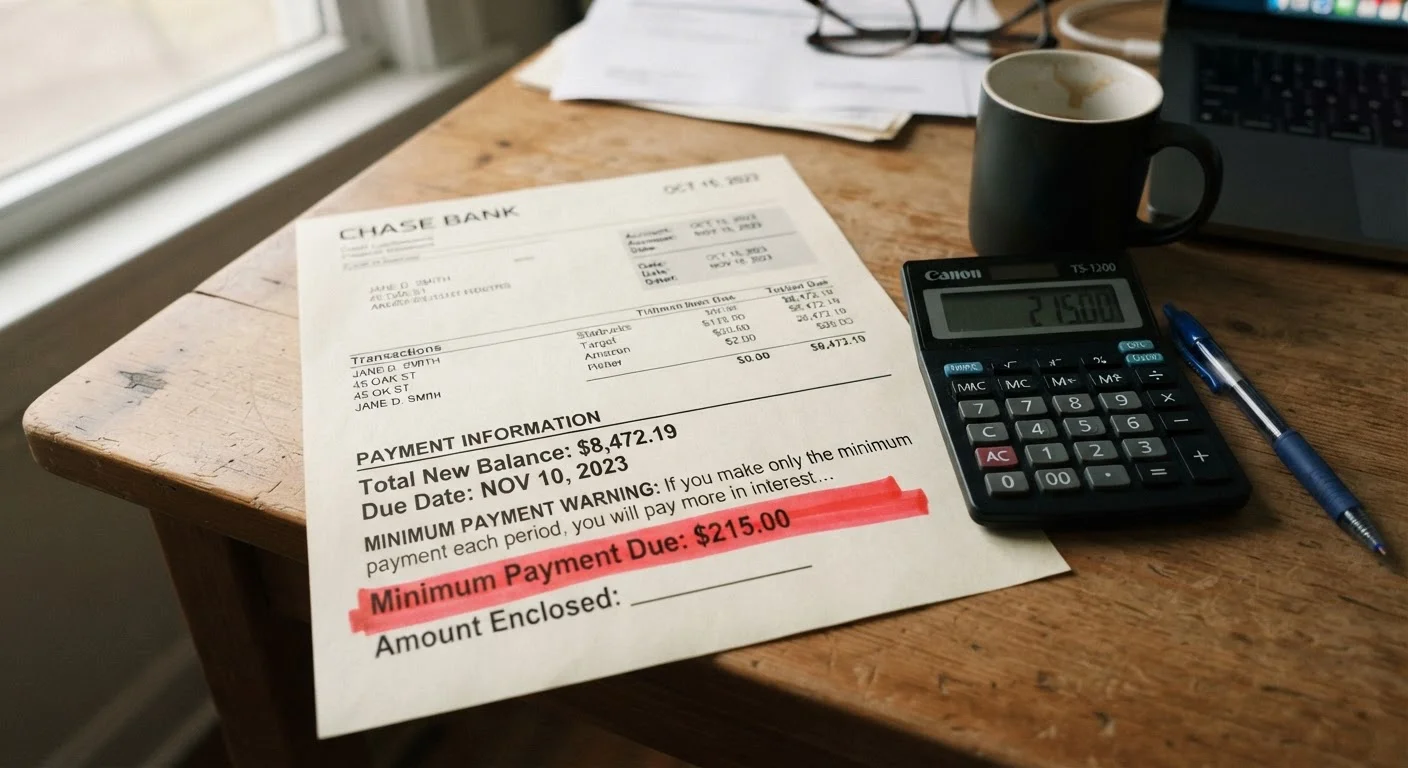
Photo: AscendWit.com | Explore Engaging Blogs. editorial
Key Takeaways
- Minimum payments are designed to keep accounts current, not to eliminate debt efficiently.
- Interest compounds on the remaining balance each cycle, causing total debt to grow slowly even as you pay.
- A $3,000 balance paid at minimum rates can take over a decade to clear and cost thousands extra in interest.
- Paying even a modest amount above the minimum can dramatically cut total interest and repayment time.
- Balancing debt payoff with saving is possible and worthwhile - you don't have to choose one exclusively.
How Minimum Payments Are Structured
Credit card issuers set minimum payments low by design. A typical calculation requires you to pay the greater of a fixed floor amount (often $25-$35) or roughly 1-3% of your outstanding balance. At first glance, that seems reasonable - but the math behind it works heavily in the lender's favor.
Consider a $3,000 balance at an 20% annual percentage rate (APR). A minimum payment might start around $60. Of that $60, approximately $50 goes toward interest charges for the month, leaving only $10 applied to the actual debt. The next month, your balance is still nearly $3,000, and the cycle repeats.
Understanding this structure is the foundation of smarter debt management. For a broader introduction to how saving and debt interact, see Personal Finance from Zero.
~14 yrs
Estimated time to repay $3,000 at minimums
Based on a 20% APR credit card with a typical percentage-based minimum payment structure.
1-3%
Typical minimum payment as a share of balance
Most major U.S. credit card issuers calculate minimums as a percentage of the outstanding balance or a fixed floor amount, whichever is greater.
20.79%
Average U.S. credit card interest rate
According to Federal Reserve data on credit card interest rates for accounts assessed interest.
The True Cost of Compound Interest
Interest on most credit cards compounds daily, not monthly. That means your lender calculates interest on your balance every single day, then adds it to what you owe. Over time, you end up paying interest on previously accumulated interest - a phenomenon that quietly inflates the total cost of borrowing.
Using the same $3,000 example at 20% APR: if you paid only the minimum each month, it would take roughly 14-16 years to pay off the debt entirely, and you could end up paying close to $3,000 or more in interest alone - essentially doubling the original amount owed. These figures vary by card terms and how minimums are calculated, but the pattern is consistent across most credit products.
“Compound interest is the eighth wonder of the world. He who understands it, earns it; he who doesn't, pays it.”
— Attributed to Albert Einstein, Widely cited in financial education contexts; original attribution is debated by historians
The same compounding principle that works against you in debt can work for you in savings. This trade-off is worth understanding - read more about balancing savings versus debt repayment to weigh your options clearly.
What Paying More Actually Accomplishes
Increasing your monthly payment - even modestly - has a compounding effect in the opposite direction. Every extra dollar above the minimum goes directly toward reducing your principal. A smaller principal means less interest charged the following month, which accelerates the payoff further.
Continuing with the $3,000 example: if you increased your monthly payment from $60 to $100, you could pay off the debt in roughly 4 years instead of 15, and save well over $2,000 in interest. Doubling the payment to $120 cuts the timeline further still.
Set a Fixed Payment Above the Minimum
This principle applies broadly across debt types. For instance, understanding what an auto loan actually costs over time reveals similar dynamics with installment debt, where front-loaded interest can surprise borrowers who pay only what's required.
If you're working within a tight budget, even redirecting $20-$30 per month from discretionary spending toward your balance makes a measurable difference. The budgeting basics hub offers practical strategies for finding that room in your spending plan.
This article is for general informational and educational purposes only. It does not constitute personalized financial or legal advice. Consult a qualified financial professional for guidance specific to your situation.
Frequently Asked Questions
The content on this site is for informational purposes only and is not a substitute for professional advice. Always consult a qualified professional for guidance specific to your situation.