
Bodyweight vs. Free Weights: Understanding the Trade-offs

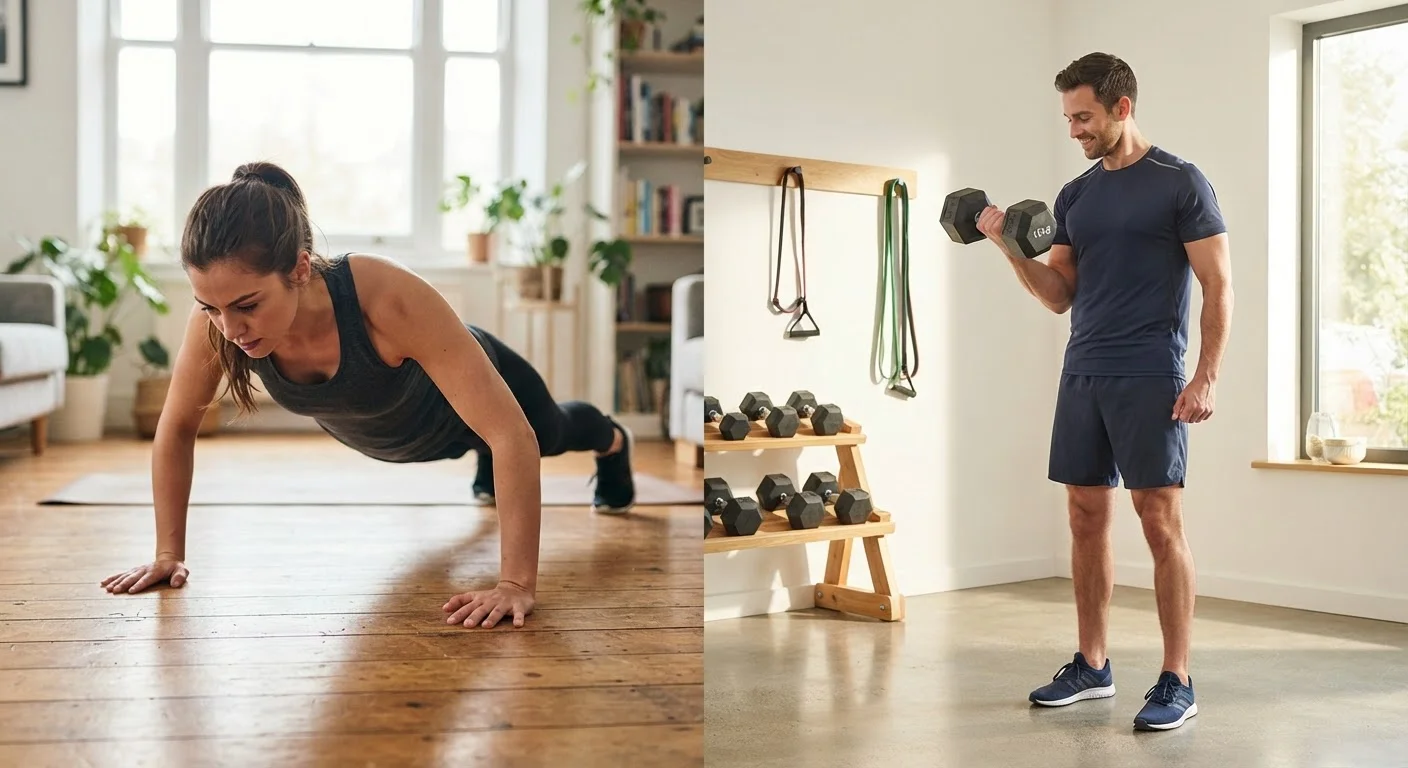
Photo: AscendWit.com | Explore Engaging Blogs. editorial
Key Takeaways
- Bodyweight training requires no equipment and is highly accessible for beginners and home exercisers.
- Free weights allow precise, incremental resistance increases that support consistent strength progression.
- Both approaches can build meaningful strength - the best choice depends on your goals and circumstances.
- Combining both methods over time often produces more well-rounded fitness results.
- Neither approach is inherently superior; effectiveness depends on consistency and proper technique.
What Each Approach Actually Involves
Bodyweight training uses your own body mass as resistance. Exercises like push-ups, pull-ups, squats, lunges, planks, and dips require no additional load - you are working against gravity using your own weight. The difficulty is adjusted by changing leverage, angle, or tempo rather than adding plates or dumbbells.
Free weights - most commonly dumbbells, barbells, and kettlebells - are external loads you add to movements. A goblet squat, a dumbbell row, or a barbell deadlift all follow similar movement patterns to bodyweight equivalents, but with a measurable, adjustable amount of added resistance. That distinction has practical consequences for how each method supports different training goals.
Understanding these foundations helps you see both options as tools, not competitors. As you think about your broader routine, it is worth reading about how cardio and strength training relate to each other as well.
Key Differences Side by Side
The table below highlights where these two approaches diverge across factors that matter most to everyday exercisers.
| Criterion | Bodyweight Training | Free Weights |
|---|---|---|
| Equipment needed | None | Dumbbells, barbells, or kettlebells |
| Cost to start | Zero | Low to moderate (equipment purchase) |
| Portability | Complete - usable anywhere | Limited - requires equipment access |
| Resistance scalability | Via exercise variations and leverage | Via precise weight increments |
| Beginner accessibility | High - low barrier to entry | Moderate - technique learning required |
| Long-term strength progression | Possible but less linear | Straightforward and measurable |
| Balance and coordination demand | High - stabilizers engaged throughout | Variable by exercise choice |
One nuance worth noting: bodyweight difficulty can be significant. Advanced movements like single-leg squats or handstand push-ups demand enormous strength and coordination. However, adding resistance in tiny increments - say, 2.5 lbs at a time - is simply not possible with bodyweight alone, which is where free weights have a structural advantage for long-term progression.
Technique Matters in Both Methods
Progression: The Core Practical Difference
Progressive overload - gradually increasing the challenge your muscles face - is the central principle behind strength development. With free weights, progression is straightforward: add a small amount of weight when the current load feels manageable. This creates a clear, trackable path.
With bodyweight training, progression works differently. You move through harder exercise variations (for example, from a standard push-up to a decline push-up to an archer push-up), manipulate tempo, reduce rest periods, or increase volume. This is effective, but the steps between difficulty levels can be larger and less predictable, which can make consistent progression feel less linear - especially for intermediate exercisers.
Neither system is flawed; they just require different mental frameworks. Tracking your progress through means beyond a scale - like reps completed, range of motion, or exercise variation achieved - is valuable in both cases. See ways to measure fitness gains that aren't weight for practical ideas.
2-4 weeks
Typical timeframe before initial strength adaptations are noticeable
Exercise science research generally suggests neuromuscular adaptations - the nervous system learning to recruit muscles more efficiently - begin within the first few weeks of consistent training with either method.
~48 hrs
Recommended recovery time between training the same muscle group
General guidance from fitness and sports medicine organizations suggests allowing roughly 48 hours of rest between sessions targeting the same muscles, applicable to both bodyweight and free-weight training.
Choosing Based on Your Real Situation
Access and environment matter as much as theory. If working out at home is your primary option, bodyweight training is a complete and legitimate starting point - and a modest set of dumbbells can extend your options considerably without requiring a gym membership. For more on this, compare home workouts and the gym to weigh the full picture.
If injury history or mobility limitations are a factor, consult a qualified fitness professional or physical therapist before beginning either program. Both methods carry injury risk when technique is poor, and bodyweight exercises are not automatically gentler - a poorly executed jump squat can stress joints just as a poorly loaded barbell can.
For many people, the most practical answer is a blend: build movement skills with bodyweight exercises, add free weights as goals and access allow, and revisit the mix as your fitness evolves. The decision is less about which is objectively better and more about which one you will actually do consistently.
This article is for general informational and educational purposes only and is not a substitute for advice from a qualified fitness or healthcare professional. Always consult a professional before beginning a new exercise program, particularly if you have existing health conditions or injuries.
The content on this site is for informational purposes only and is not a substitute for professional advice. Always consult a qualified professional for guidance specific to your situation.